“A-HELP” (Accredited Agent for Health and Extension of Livestock Production)
To promote rural economic growth through the Self-Help Group (SHG) platform, the Department of Animal Husbandry and Dairying and the National Rural Livelihoods Mission under the Ministry of Rural Development, Government of India, signed a Memorandum of Understanding (MoU) on 1 September 2021.
Under this initiative, selected SHG members are trained and accredited to serve as Livestock Resource Persons and Primary Service Providers through a community-based model known as A-HELP (Accredited Agent for Health and Extension of Livestock Production).
Existing Livestock Service Network
At present, 541 Veterinary Dispensaries/Hospitals (VD/VH) and 3,239 Livestock Aid Centres (LACs) are functioning in the state, providing livestock health services across 6,794 Gram Panchayats (GPs).
In addition, Artificial Insemination (AI) services are delivered by Artificial Insemination Technicians (AITs) engaged through Odisha State Cooperative Milk Producers’ Federation (OMFED), as well as MAITRIs working under the Rashtriya Gokul Mission. Local veterinary institutions are also actively involved in implementing various livelihood schemes and development programmes in the animal husbandry sector.
However, in some Gram Panchayats where government veterinary institutions are not available, livestock owners depend mainly on OMFED AITs and MAITRIs for basic services such as artificial insemination and preventive vaccination. Due to their limited scope of work, they have little opportunity to conduct broader animal husbandry extension and advisory activities.
To bridge this gap, a new cadre of community-based service providers, known as Accredited Agents for Health and Extension of Livestock Production (A-HELP), has been introduced.
Role of A-HELP Workers
An A-HELP worker serves as the first point of contact for livestock health-related needs at the village level. Their services are particularly important in Gram Panchayats where government veterinary institutions, OMFED AITs, or MAITRIs are not available, or where livestock owners face difficulty accessing veterinary healthcare services.
The key activities of A-HELP workers include:
-
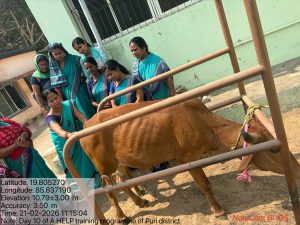
Assisting in livestock vaccination and disease prevention programmes
-
Conducting deworming activities
-
Providing basic first aid for animals
-
Organizing livestock awareness and extension camps
-
Supporting farmers with scientific animal husbandry practices
Through these services, A-HELP workers strengthen last-mile delivery of livestock health services and contribute to improved livestock productivity and rural livelihoods.
A-HELP Training Programme
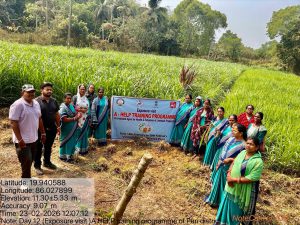
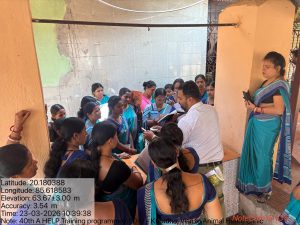
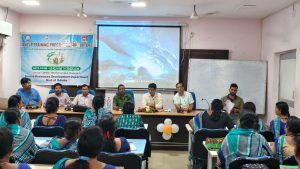
The first batch of the A-HELP Training Programme was conducted for 25 Pranimitras from 13 December to 29 December 2024 at the Animal Husbandry Departmental Staff Training Institute and Extension Training Centre(AHDSTI&ETC) in Bhanjanagar, Ganjam.
As of March 2026, a total of 39 batches of A-HELP training programmes have been successfully conducted, covering 955 Pranimitras.
The trained A-HELP workers are now actively serving in their respective areas by carrying out vaccination, deworming, basic first aid for livestock, and organizing awareness camps for farmers.
This initiative has significantly strengthened community-level livestock service delivery and enhanced the capacity of rural communities in livestock management and animal health care.
 |
|  |
|  |
|  |
|